medilearn tst website logo

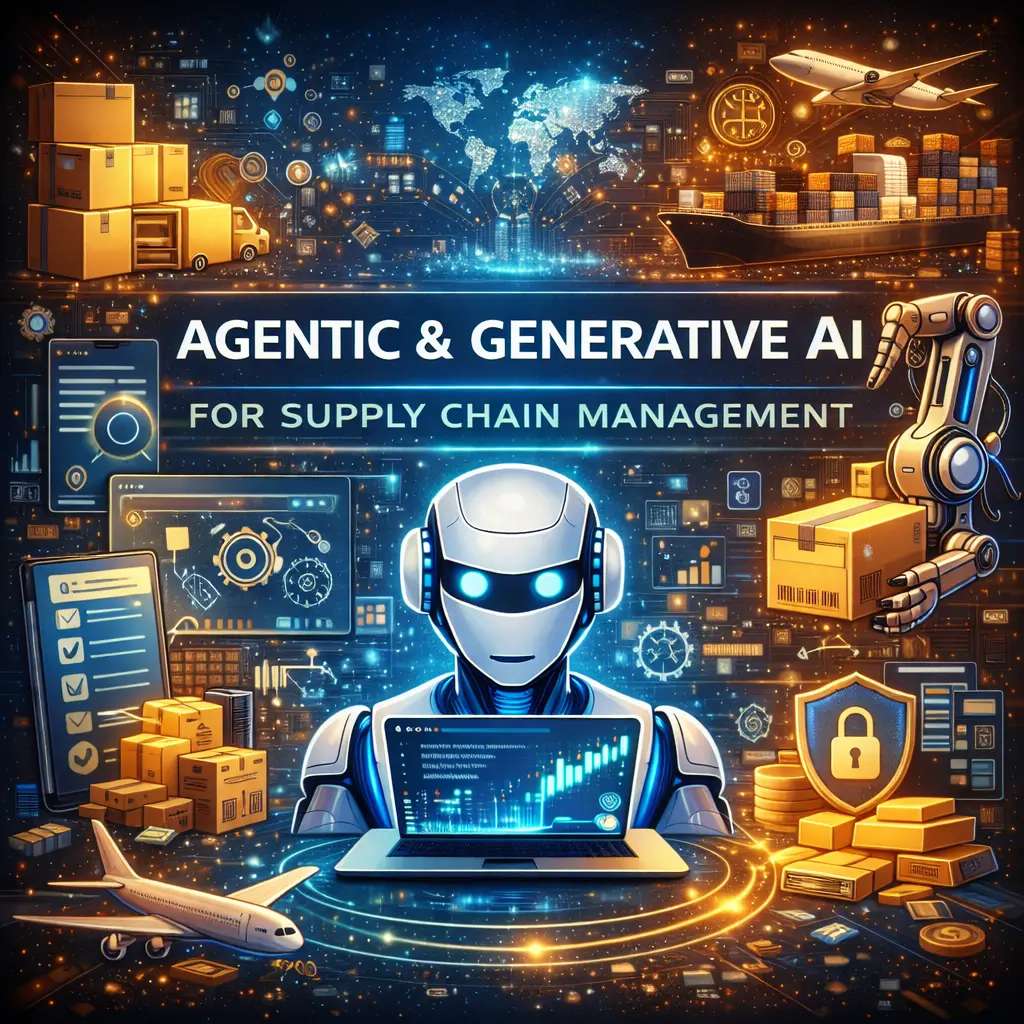
Agentic & Generative AI for Supply Chain Management

4.5 (300–500+ Learners)

Learn from industry experts with hands-on projects & live mentorship

KHDA_Dubai
Agentic & Generative AI for Supply Chain Management

8 Sessions

Duration – 16 Hours

English / Arabic

Certificate of Completion

Fundamentals of Generative AI, Agentic AI, and large language models

AI frameworks for identifying high-impact supply chain use cases

Applying AI across planning, logistics, manufacturing, and inventory management

Hands-on exposure to AI agents, copilots, and intelligent workflows

Case studies from leading supply chain and manufacturing organizations

Classical ML vs Generative AI, AGI, and Agentic AI

LLM fundamentals: tokenization, embeddings, fine-tuning, and RAG

Prompt engineering, AI agents, multi-agent collaboration, and workflows

AI copilots, chatbots, and business AI tools

Supply chain optimization using AI: demand forecasting, inventory, logistics, and manufacturing

AI-powered quality inspection, predictive maintenance, and safety

Understand core concepts of Generative AI, Agentic AI, and AI agents

Identify and prioritize AI use cases across the supply chain value chain

Apply LLMs, AI agents, and workflows to optimize supply chain operations

Design AI solutions that move from pilot to production

Apply responsible AI, risk, and regulatory frameworks in SCM applications

About the Course & Benefits
This course provides a practical understanding of how Generative AI, AI agents, and large language models are transforming supply chain planning and operations. It combines foundational AI concepts with real-world use cases, enabling participants to design and deploy AI-driven solutions that enhance efficiency, resilience, and business outcomes.

Benefits included:

KHDA + Medilearn certification

Gain insights into enterprise AI use cases in SCM

Identify, design, and pilot AI initiatives in operations

Understand responsible AI, governance, and regulations

Course Circulation

Module 1

Foundations of Generative & Agentic AI

Module 2

Working with LLMs, Prompts, and AI Agents

Module 3

Business AI Frameworks and Enterprise AI Tools

Module 4

Responsible AI, Ethics, and AI Regulations

Module 5

Applying GenAI & ML to Supply Chain Use Cases

Module 6

Hands-on Exercises and Industry Case Studies in SCM

MediLearn Certificate

Earn a Course Completion Certificate, an official credential from MediLearn, recognizing your dedication and hard work throughout the program. This certificate confirms that you have successfully met all course requirements, including assessments, practical activities, and guided learning sessions. It serves as a trusted proof of your newly acquired knowledge and skills, valued by employers and professional institutions. Display it with pride on your resume, LinkedIn profile, or portfolio to strengthen your professional credibility and career opportunities.

Student Success Stories

“Education is one of the most essential and valuable assets that an individual can possess, It plays a pivotal role in shaping.”

FAQs

How can AI be used in supply chain management?
Artificial intelligence can be used in supply chain management to enhance planning, execution, and decision-making across the end-to-end value chain. AI applications include demand forecasting, inventory optimization, logistics planning, manufacturing optimization, quality inspection, and predictive maintenance. The Agentic & Generative AI for Supply Chain Management course trains learners to identify high-impact use cases and apply Generative AI, AI agents, and intelligent workflows to real-world supply chain operations, with an emphasis on enterprise deployment, resilience, and measurable business outcomes.
There is no single AI technology that is universally optimal for all supply chain applications. Instead, effective supply chain transformation relies on a combination of AI approaches. Generative AI supports planning, reporting, and decision intelligence; Agentic AI enables autonomous and semi-autonomous workflows; and large language models (LLMs) enhance coordination, analysis, and operational efficiency. This course equips learners to evaluate and select appropriate AI frameworks based on supply chain context, operational complexity, and business objectives.
AI cannot fully replace supply chain functions but can significantly augment them. While AI excels at data analysis, optimization, and automation of repetitive tasks, strategic decision-making, exception handling, and stakeholder management continue to require human expertise. The course emphasizes human-in-the-loop AI systems, where AI supports planners and managers by improving speed, accuracy, and insight rather than replacing core supply chain roles.
The future of AI in supply chain management is characterized by increased adoption of Agentic AI systems, intelligent copilots, and end-to-end AI-enabled workflows. Organizations are expected to move from isolated pilots toward enterprise-wide AI deployment that enhances resilience, responsiveness, and sustainability. This course prepares learners to design AI solutions that progress from experimentation to production while incorporating governance, ethics, and regulatory considerations.
AI is reshaping supply chain roles rather than eliminating them. Routine and repetitive tasks are increasingly automated, while demand grows for professionals who can interpret AI outputs, manage AI-driven systems, and make strategic decisions. The course focuses on upskilling supply chain professionals to work effectively alongside AI systems, enabling career relevance in AI-enabled supply chain environments.
Key risks associated with AI in supply chain management include data quality issues, model bias, lack of transparency, over-reliance on automated decisions, and regulatory non-compliance. Cybersecurity and ethical concerns also present challenges in enterprise AI adoption. The course addresses these risks through dedicated coverage of responsible AI, governance frameworks, and regulatory considerations to ensure safe and compliant AI deployment in supply chain contexts.
AI is unlikely to replace procurement jobs but will transform procurement practices. AI can automate spend analysis, supplier evaluation, contract review, and risk assessment, allowing procurement professionals to focus on strategic sourcing, supplier relationships, and value creation. This course prepares learners to apply AI tools in procurement while maintaining human oversight, ethical judgment, and regulatory compliance.

Education focused website or template is an essential part that provides visitors with insights into the program or service offered.

Online Platform

Contact us

042565305/ +97142565305

info@medilearntst.com

Montana Building, Office No 501, 5th Floor Karama, Dubai United Arab Emirates

Scroll to Top

Fill out the form below, and we will be in touch shortly.